Washington DC monuments are easy to recognize. Their deeper meaning can be much harder to see.
A tall white obelisk honors the country’s first president. Thirty-six columns surround Abraham Lincoln. Thomas Jefferson stands inside a circular classical building. Martin Luther King Jr. appears to emerge from a massive piece of stone.
None of those choices happened by accident.
The monuments around Washington were shaped by decades of debate, changing ideas about national memory, and carefully chosen architectural details. Understanding those stories can completely change the way you see the National Mall.
Here are four famous Washington DC monuments and the stories behind what they represent.
1. The Washington Monument Took Decades to Finish
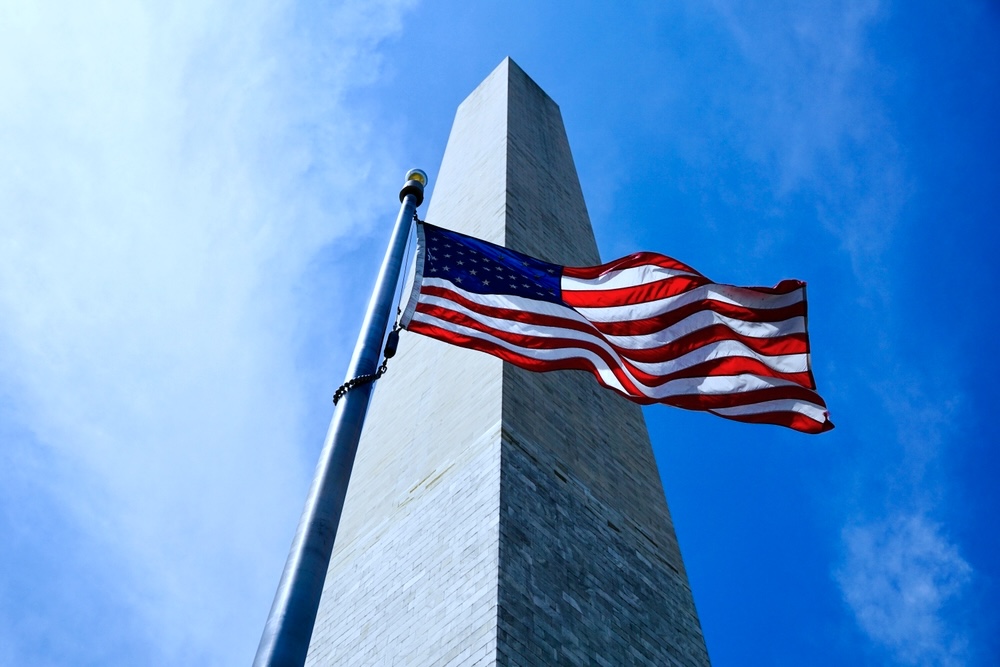
The Washington Monument looks remarkably simple. Its history was anything but.
Plans to create a major memorial to George Washington developed after his death in 1799. The Washington National Monument Society formed in 1833 and eventually selected architect Robert Mills’ design.
His original proposal was much more elaborate than the monument you see today.
Mills envisioned a 600-foot Egyptian-style obelisk surrounded by a circular structure containing statues of Revolutionary War figures. Cost and construction challenges eventually pushed the project toward a simpler design.
Construction began in 1848.
Then the money ran out.
Work stopped during the 1850s when the monument had reached only about 150 feet. Political disputes and the Civil War helped keep construction stalled for decades.
Congress eventually provided federal funding, and construction resumed in the late 1870s.
If you look closely, you can still see evidence of the interruption. The marble changes color partway up the monument because builders had to use stone from different quarries when work resumed.
The completed monument reached 555 feet, 5 1/8 inches. When construction ended in 1884, it was the tallest building in the world.
Its obelisk form also carried meaning. The shape connected Washington with the permanence and grandeur associated with ancient civilizations.
Today, its clean appearance hides a complicated building story spanning generations.

2. The Lincoln Memorial Is Really a Monument to the Union
Most visitors naturally focus on Abraham Lincoln’s enormous seated figure inside the Lincoln Memorial.
Look outside first.
Thirty-six Doric columns surround the building. They represent the 36 states that belonged to the Union when Lincoln died in 1865.
That number turns the entire structure into something larger than a presidential memorial.
Architect Henry Bacon designed the building in the form of a Greek temple. He believed a memorial honoring a leader who defended representative government should draw inspiration from the architecture associated with ancient democracy.
Construction began in 1914, almost 50 years after Lincoln’s assassination. The memorial was dedicated in 1922.
Inside, Lincoln sits between inscriptions of two defining speeches, the Gettysburg Address and his Second Inaugural Address.
Both speak directly to the themes carried through the building: national unity, sacrifice, equality, and reconciliation.
Those ideas later gave the memorial another role.
Its steps became a gathering place for Americans demanding that the country’s promises apply more equally. In 1963, Martin Luther King Jr. delivered his “I Have a Dream” speech there during the March on Washington.
That history gives the Lincoln Memorial two connected meanings.
It commemorates the president who fought to preserve the Union. It also became a place where later generations challenged the nation to fulfill the ideals that Union claimed to represent.
3. The Jefferson Memorial Uses Stone to Tell a Story
The Thomas Jefferson Memorial may look like one uniform white structure.
It isn’t.
Different stones were deliberately selected to represent different parts of the country.
The exterior uses Vermont marble. Interior walls use marble from Georgia. Together, those materials symbolize the geographic span of the original 13 states from New England to the South.
Other materials extend that story westward.
The floor includes Tennessee marble, while Indiana limestone appears in the dome. Jefferson’s bronze statue stands on Minnesota granite surrounded by Missouri marble. Parts of Minnesota and Missouri came from territory connected with the Louisiana Purchase during Jefferson’s presidency.
Even the building’s circular, classical design relates to Jefferson.
Architect John Russell Pope drew heavily from classical Roman architecture. Jefferson himself admired that tradition and used classical forms in buildings he designed, including his home at Monticello and the University of Virginia.
The memorial was dedicated on April 13, 1943, the 200th anniversary of Jefferson’s birth.
There was one unusual complication.
World War II restrictions made bronze difficult to obtain. As a result, visitors initially saw a temporary plaster version of Jefferson’s statue. The 19-foot bronze figure now inside the memorial replaced it in 1947.
The monument therefore tells its story through more than inscriptions. Its stone, architecture, location, and materials all contribute to the message.
4. The Martin Luther King Jr. Memorial Turns His Words Into Stone
The Martin Luther King Jr. Memorial takes one of King’s most famous ideas and makes it physical.
As you enter, you encounter two enormous pieces of granite called the Mountain of Despair.
Beyond them stands another piece of stone pulled forward from that mountain. This is the Stone of Hope, where King’s likeness is carved.
The entire design comes from a line in King’s 1963 “I Have a Dream” speech about creating hope from despair.
Instead of simply placing a statue on a pedestal, the memorial asks you to walk through the metaphor.
The location adds another layer.
The memorial sits between the Lincoln and Jefferson memorials. King referred to both the Emancipation Proclamation and Declaration of Independence in his famous speech. Its placement creates a physical relationship between those earlier American promises and King’s struggle to see them fulfilled more completely.
An inscription wall contains quotations from King’s speeches, sermons, and writings. Together, they explore themes including justice, democracy, peace, and love.
The memorial opened in 2011.
Unlike Washington, Jefferson, and Lincoln, King was never president. His presence in this monumental landscape reflects another kind of national influence.
The memorial honors a citizen activist whose words and leadership changed the country’s understanding of civil rights.
Washington DC Monuments Make More Sense When You Slow Down
The most recognizable Washington DC monuments aren’t simply large objects placed around a park.
Their columns have meaning. Their stones were chosen deliberately. Their locations create relationships with other landmarks. Even construction delays can leave marks that remain visible more than a century later.
That’s why Washington rewards closer exploration.
Urban Adventure Quest’s Washington DC scavenger hunt gives you a different way to experience the capital.
Your smartphone-guided Quest begins near the Smithsonian Castle and takes you through the National Mall before continuing into downtown Washington.
Along the 3.3-mile route, your team tackles 18 challenges and four bonus challenges. You move at your own pace, so you can stop to explore, take photos, or spend extra time with a landmark that catches your attention.
The Quest eventually leads you to Ford’s Theatre, adding another major chapter of American history to the experience.
You’ll see famous Washington sights, but you’ll also have a reason to examine the details around them.
Because in Washington DC, the story isn’t only written on the monuments.
Sometimes it’s built right into them.
Start Your Quest and discover the stories behind the capital.